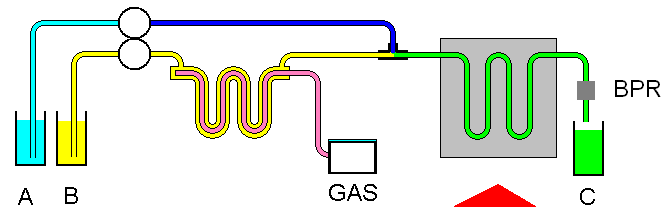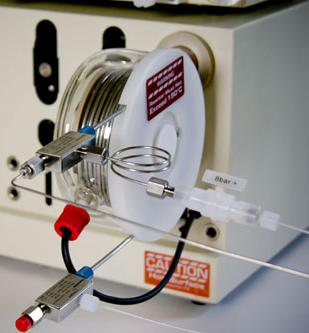
Vapourtec Gas / Liquid Membrane Reactor
|
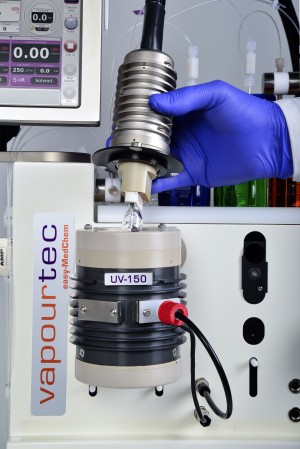
The new Vapourtec Tube in Tube Gas Reactor (right) , shown running at 100oC The new reactor coil fits into the standard Vapourtec reactor manifold (just like the PFA, stainless steel or copper reactor coils already available), so is compatible with all existing R Series systems immediately, with no upgrading required.
Liquid is fed through the coil just like any other reactor, but there is also a connection for gas which is fed at the desired pressure from a regulated supply.
The reactor can be used in two ways
|
|
Pre-dissolving the gas in the reagent stream
|
This method involves saturating one reagent stream with gas before the reaction itself. It is limited by the solubility of the gas in the reagent and solvent liquid stream, which for some gases will impose quite a significant limitation on the concentration at which the reaction can be run with useful conversion. |
|
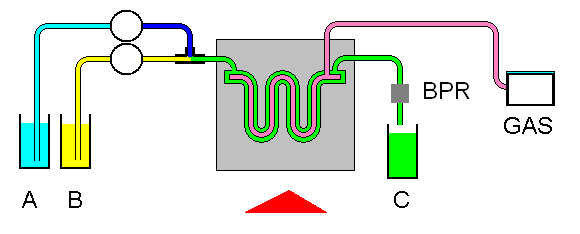
Feeding the gas into the reaction as it is consumed
|
Because the new Vapourtec reactor is compatible with the existing R4 reactor heater, it is possible to use it for the main reaction, controlling the reaction temperature as required while feeding in gas. Therefore the solubility of the gas in the solvent/reagent is no longer the limiting factor. As gas is consumed by the reaction, more is fed into it.
|
|
This is where the Vapourtec reactor is unique. Hydrogenations, for example, have to be performed in a very dilute solution of if the solubility of hydrogen is the limiting factor, but with this new reactor hydrogenation at 1M is easily achieved.
The rate at which gas diffuses into the liquid stream is determined by the pressure of the gas, the temperature at the membrane, and the gas molecule in question.
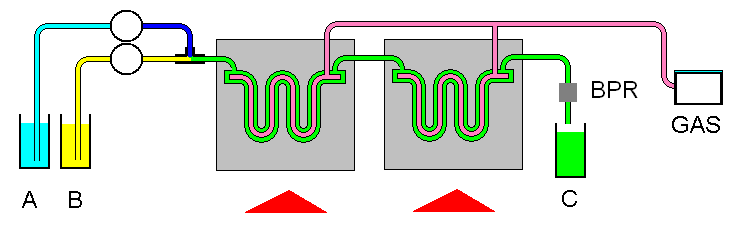
Using Multiple Gas Reactors
|
If required it is possible to increase the scale of the reaction and the gas flow by using more than one reactor in series. The Vapourtec system can heat up to four gas membrane reactors in series. |
|
FAQ
Q Is this new reactor coil compatible with my existing Vapourtec glass manifolds ?
A Yes.
Q Is the reaction visible ?
A No, stainless steel is used for the outer tube
.
Q Is this compatible with my existing FlowCommander™ software ?
A Yes, Flow Commander™ just needs to know the reactor volume and all collection timings will be correctly calculated
Q What temperature range is this available for
A Ambient to 150oC (in a standard glass manifold).
Q Is there a high temperature version (up to 250 oC)
A No
Q Is there a strong acid resistant version ?
A No, stainless steel.is used as part of the wetted path
Q Is there a cooled (below ambient) version of the larger reactor ?
A Not at this time. However, note that an exothermic reaction above ambient can be effectively controlled, as with all Vapourtec reactors.
Q Is the reactor temperature under the control of FlowCommander software ?
A Yes, it is controlled just like any other reactor in the Vapourtec system. So you can use FlowCommander to automate a series of gas reactions at different temperatures. Or if you do not use FlowCommander, the temperature is set using the R4 front panel.
Q How quickly can the temperature be changed ?
A As with all Vapourtec reactors, the thermal inertia is small, so temperature set point changes are rapid, whether the temperature is rising or falling.
Q How accurate is the temperature measurement ?
A The temperature probe measures the temperature at the steel wall of the reactor liquid tube, so is absolutely representative of the liquid temperature.
Q How is the gas controlled
A The user feeds gas via a simple pressure regulator into the gas ports on the reactor. No mass flow control is required.
|
Q How much does this reactor cost ? A Please contact Vapourtec. It is very cost effective compared to other alternatives.
Q When is this item available for delivery ? A 1st July 2011 |
![]() |
Q Has this been used for actual work yet ?
A This publication uses the Vapourtec gas reactor.
Q What gases can this be used for
A Testing so far has been done with H2, CO, O2 .
Q What about Ozone ?
A Typically ozone is available as a perhaps 10% in oxygen. Using the reactor as shown above would result in a build up of (unconsumed) oxygen in the gas part of the reactor. Continuous flow of gas in and out of the membrane would be required (perhaps by a metered vent). While quite possible, this has not been the subject of any development work yet
There is of course a different way to do ozonolysis withteh Vapourtec system, as shown here
Q What is the concentration of reagents that can be used?
A Testing so far has been completed with reagent concentration in the reactor of between 0.5M and 1.0M.
Q Is it necessary to recycle the reagents through the reactor multiple times ?
A No. All testing so far has involved a single pass through the reactor system to collection.
Q I already have an R series system – what do I need to start using this ?
A You will need the new reactor plus a regulated supply of the gas in question that can be connected to the reactor gas ports. A finely adjustable pressure regulator up to 20 bar with a calibrated gauge is recommended.
Q Are there safety considerations
A It is advisable that your gas supply includes a flow restriction so that in the worst case event of a leak the flow rate of gas that could actually be emitted from the system would be small, and easily extracted by the fume cabinet. The pressurised gas volume of the Vapourtec reactor is small (< 10ml) so represents very little stored energy.
About Gas Reactions
Q How can I tell if my reaction is gas limited ?
A If there is an excess of dissolved gas at the end of the reaction, then you will probably see bubbles of gas in the output stream after the Back Pressure Regulator (BPR) when the pressure is released. If there are no bubbles, all the gas has been consumed by the reaction, and it may be gas limited.
Q What if I don’t get enough gas flow for full conversion
A It is possible to extend the residence time by lowering the flow rate or by using multiple consecutive gas reactors. The R Series system permits the use of up to 4 reactors in series.